The Brickworks of John G. Stein
The industrial heart of Allandale village, where generations of workers shaped clay into the bricks that built Scotland.
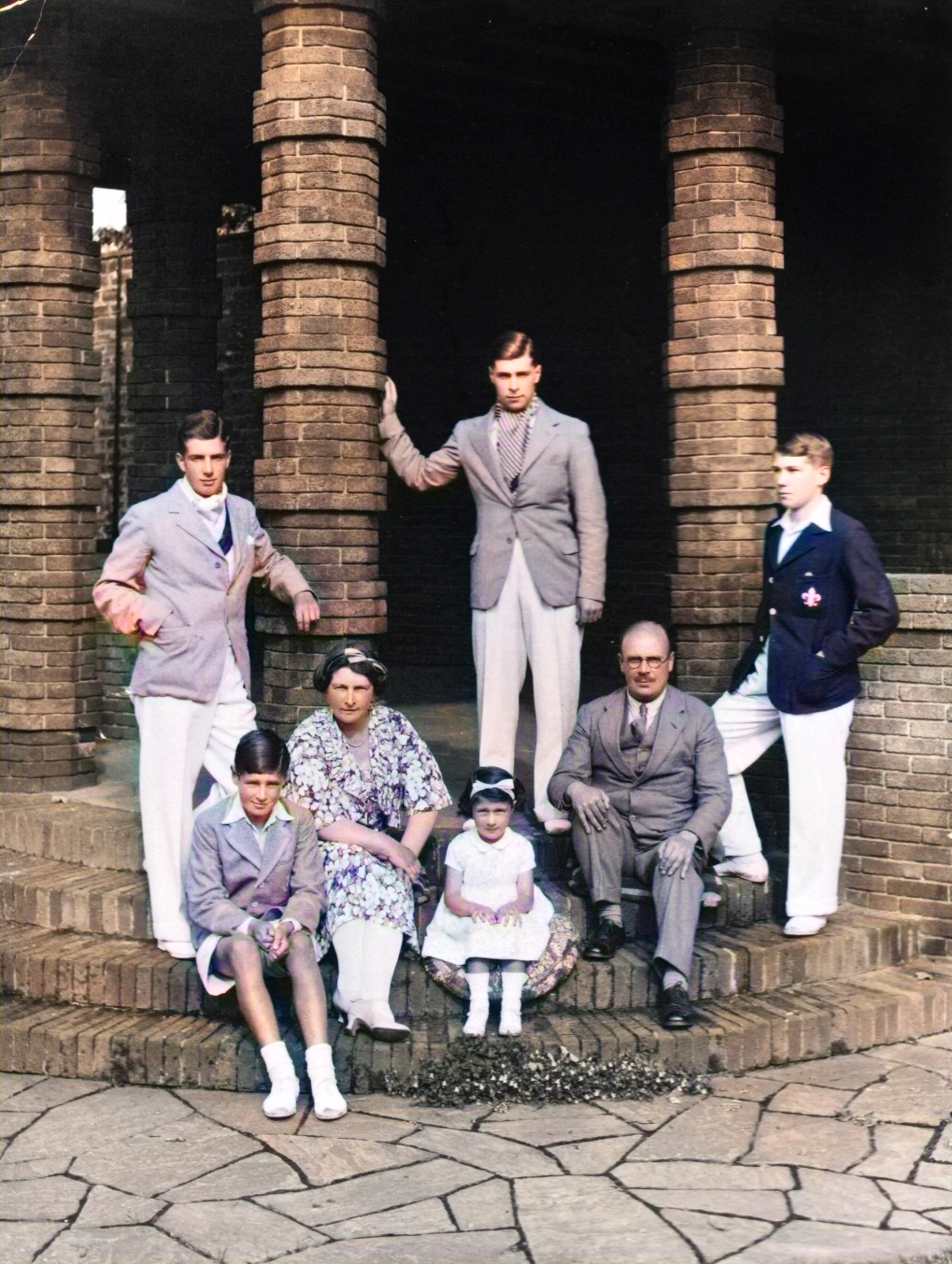
Workers and their families at the John G. Stein brickworks, with the distinctive brick kilns in the background
The brickworks of John G. Stein were opened at Castlecary Works in 1903 on ground owned by the Marquis of Zetland. The company had other works at Denny and Milnquarter Works at High Bonnybridge. The houses in Allandale were started soon after. The original owner John G. Stein died in 1927 as the result of a slight accident on the works which developed into gangrene. His son, Colonel Alan Stein took over as managing director. He had been an officer in the 7th Argyll and Sutherland Highlanders. He purchased Millfield Estate in Polmont in 1912 for £5,900 and this was the family home for many years. He died in 1954 and left a small sum of money to every employee who had served at least one year. The first manager was Charles Taylor, known as Old Charlie, who retired in 1945. Harry McGregor took over for a short time until Alex Birse, called Sanny became the manager and eventually a director.
As has been said before, all the householders in Allandale has to be an employee of John G. Stein except for any who had retired but there was not many of them. They were not the only source of labour as special buses brought workers from Airdrie, Kilsyth, Twechar, Denny, Bonnybridge. Haggs, Banknock and Falkirk. At its peak the works employed app. 600 people and they built another works at Whitecross, Manuel Works, later. Most of the brickworks in Scotland were built on a line across the central belt as the clay seam ran along this. The larger firms would buy up smaller firms to get access to their clay supplies. Women as well as men were employed in the works but they were only employed in certain areas such as taking the newly made bricks from the Bradley machines, laying them out on the floor to dry then working alongside men in loading the dried bricks into the kilns for burning. Only men unloaded the kilns after burning. The hand moulders who made the more intricate shaped bricks were all men. All these operations with the exception of the machine operators were on piecework and they were usually finished by mid-afternoon.
Working Hours and Conditions
The factory hooter sounded at 6.30am and again at 6.55am. The hourly paid workers including all the tradesmen worked 44 hours per week in the 1940s and early 1950s. They started at 7am and finished at 5pm with 30 minutes off for breakfast at 9.30am and 40 minutes for lunch at 1pm The office staff worked from 9am until 5pm. Many of the workers from Allandale went home for their meals and the others either ate in the works canteen which supplied good hot meals or took a 'piece' with them and ate it at various convenient places.
The works canteen started in February 1941 after a meeting presided over by Mr. Charles Taylor, the works manager, was held with the view to forming a committee to run it. The directors had agreed to fund the provision of the cooking facilities, utensils and the staff for the canteen which would then be run by the committee.
Safety and Working Conditions
The working conditions were not very good. Steam heating was run under all of the floors to dry the bricks and it was exceptionally hot in the summertime. Long service employees could usually be identified by having one or more fingers missing. This was mainly caused when using the small brick presses which were kept moving all the time. In fact, my father was killed in the works in 1947 by an injury to his head. Silicosis was also a hazard for many caused by inhaling silica dust over a long period resulting in serious lung damage.
Production and Distribution
The continuous kilns in which the bricks were fired were all coal fired and the coal came into the works on railway wagons. The fireman would shovel the coal into the fires at the correct rate so that the temperature inside the kilns was correct. Later, the kilns were oil-fired which produced different problems.
All the bricks were despatched from the works by rail and there were two sidings which ran right through the works. Stein exported bricks all over the world and they were usually shipped out of Grangemouth or Glasgow. During the 1960s the houses were passed over to the control of the Stirling County Council.
Two Peculiar Stories
(which I am told are true)
I was offered two copies of a technical manual by Kenneth Sanderson, a Stein's director, which had been found on a bookstall in Albania by a tourist.
A soldier from Steins who was serving in North Africa was tramping through the desert when he stumbled on something buried in the sand. When he checked to see what it was he uncovered a Steins firebrick.